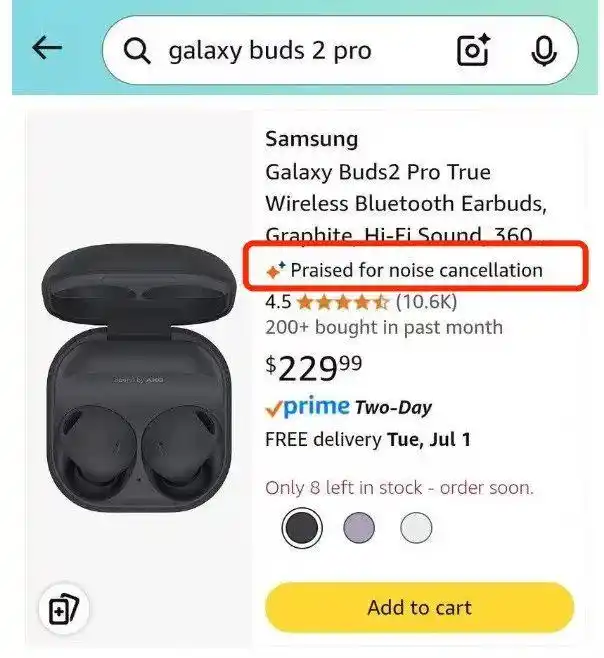

Amazon’s AI algorithm Rufus has officially launched its intelligent summary tags, which appear in prime positions—above the product rating on mobile and below the main image on desktop. These tags are quietly reshaping the traffic logic and conversion paths of product listings. Unlike traditional manual optimization, Rufus tags are entirely automatically extracted by AI and directly linked to users’ core needs. This means sellers must shift from “pleasing keywords” to “understanding user intent and adapting to AI algorithms.” Here are 5 core optimization strategies to help you turn Rufus tags into a “booster” for traffic and conversions.
1. Title: From “Keyword Stuffing” to “Precise Intent Delivery”
The core of Rufus tags is to “extract the match between products and user needs.” As the “first impression” of a listing, the title must directly convey users’ usage scenarios and core demands.
- Wrong Example: Only listing keywords, such as “Outdoor Backpack Large Capacity Waterproof Travel” (AI cannot determine the applicable scenario or user group).
- Optimization Direction: Combine usage scenarios with user identities, e.g., “Family Camping Special Large-Capacity Waterproof Backpack, Suitable for 3-5 Day Short Trips.”
- Principle: Clear information like “family camping” and “3-5 day short trips” in the title allows Rufus to quickly identify the product’s core usage scenario, generating precise tags such as “Perfect for family camping trips.”
2. Bullet Points: Become a “Repository of User Questions and Answers”
Rufus tags essentially “answer users’ potential questions in advance,” and bullet points are the core source from which AI extracts answers. Sellers need to break away from the “parameter listing” mindset and proactively anticipate possible user questions while providing specific answers.
- Wrong Example: Only writing “Material: Oxford cloth; Capacity: 30L; Weight: 1.2kg” (pure parameters cannot reflect user value).
- Optimization Direction: Use a “user question” framework, such as:
-
- “Can it hold camping gear? The 30L large capacity can accommodate a full set of camping supplies like tents and sleeping bags, with a layered design to avoid clutter.”
-
- “Will it leak in the rain? Made of thickened Oxford cloth with a waterproof coating, it can keep the interior dry in moderate rain.”
- Principle: Rufus prioritizes capturing “question + solution” expressions, converting them into pain point-targeting tags like “Spacious enough for camping gear” and “Waterproof for rainy days.”
3. A+ Content and Visual Materials: “Scene-Based” Feeding for AI
Rufus not only recognizes text but also relies on scene information in images and videos to determine the product’s target audience. Visual materials need to upgrade from “product display” to “scene immersion.”
- Image Optimization:
-
- Take “people + scene” combination photos (e.g., “A family of three organizing backpacks at the campsite” or “Office workers carrying laptop bags over one shoulder during commutes”).
-
- When filling in image keywords, add scene details (e.g., “Large-capacity backpack organized by parents during family camping”).
- A+ Content Optimization:
-
- Add a “scene comparison” module (e.g., “Commuting scene: Easily holds a laptop + documents; Travel scene: The expandable layer can hold change of clothes”).
-
- Use text-image combinations to mark “user pain point solutions” (e.g., “Backpack side pocket design—solves the problem of water bottles easily falling out”).
- Principle: Scene-based content helps Rufus clarify “who the product is for and in what scenarios it is used,” generating more immersive tags such as “Great for commuters and travelers.”
4. Search Terms and Backend Attributes: Supplementing the “AI Semantic Puzzle”
Rufus relies on “semantic understanding” rather than “keyword matching.” Therefore, Search Terms and backend attributes need to supplement “reasons for purchase” and “usage scenarios” instead of repeating title keywords.
- Search Terms Optimization:
-
- Add “user motivations” (e.g., “campers need large capacity backpack” “commuters want anti-theft laptop bag”).
-
- Supplement “scene details” (e.g., “backpack for weekend family trips” “waterproof bag for rainy commutes”).
- Backend Attribute Optimization:
-
- Fully fill in non-mandatory items such as “usage scenarios” and “target groups” (e.g., “Applicable scenarios: camping, travel, commuting” “Target users: families, office workers”).
-
- Add “user-perceived value” in specifications (e.g., “Weight 1.2kg—30% lighter than similar products, suitable for long-time carrying”).
- Principle: This information helps Rufus improve its “semantic cognition” of the product and enhance the matching degree between tags and user search intent.
5. Linking Reviews and QA: Fixing “Tag Vulnerabilities”
Rufus captures high-frequency feedback in reviews and QA. If there are negative keywords (e.g., “not waterproof,” “small capacity”), it may generate unfavorable tags. Sellers need to proactively “identify and fill gaps”:
- Negative Review/QA Monitoring:
-
- Regularly count high-frequency questions (e.g., “Many users ask ‘Does it have a USB charging port'”) and clearly respond in the listing (e.g., “With a side USB charging port for convenient charging during trips”).
-
- If negative reviews focus on a certain defect (e.g., “easily broken shoulder straps”), emphasize improvements in the description (e.g., “Upgraded thickened shoulder straps, with a load-bearing capacity increased to 15kg”).
- Proactively Guiding Positive Reviews:
-
- Place “positive review guide cards” in packages, prompting users to mention core scenarios (e.g., “If you think the backpack is suitable for family camping, welcome to share in the review”), increasing the density of positive scene keywords.
Conclusion: The Underlying Logic of Adapting to the “AI Semantic Era”
The essence of Rufus new tags is that Amazon is advancing the “user decision-making process”—allowing buyers to confirm “whether this is the product they need” through tags before seeing the detail page. For sellers, the core of optimization is not “making AI generate a certain tag” but “making every detail of the listing accurately match users’ real needs.”
When titles, descriptions, visual materials, and backend information form a “user intent closed loop,” Rufus will naturally generate high-conversion tags, bringing you continuous organic traffic dividends. Instead of passively waiting for algorithm adjustments, it is better to actively embrace the new rules of “user intent + AI semantics”—this is the key to competition in the second half of Amazon’s journey.