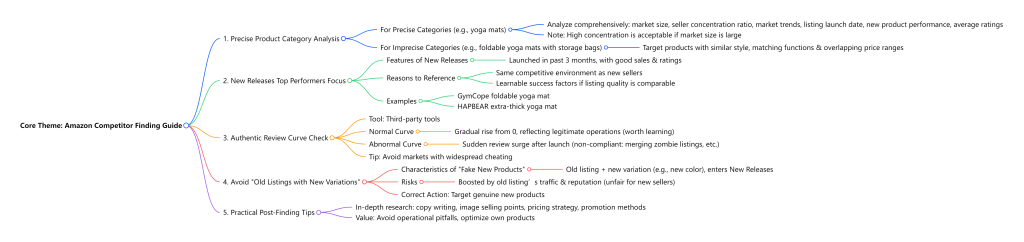

Let’s talk about a crucial question for Amazon sellers today – how to find your competitors quickly and accurately? For sellers, especially newbies just starting out, identifying the right competitors is way more efficient than fumbling around on your own. After all, competitors are the best teachers! Their product bundles, listing images and copy, keyword optimization, even pricing and promotion strategies – all these are actionable insights you can learn from directly.
Below are four practical core dimensions to help you find competitors. They’re easy to apply right after reading.
1. Start with Precise Product Categories
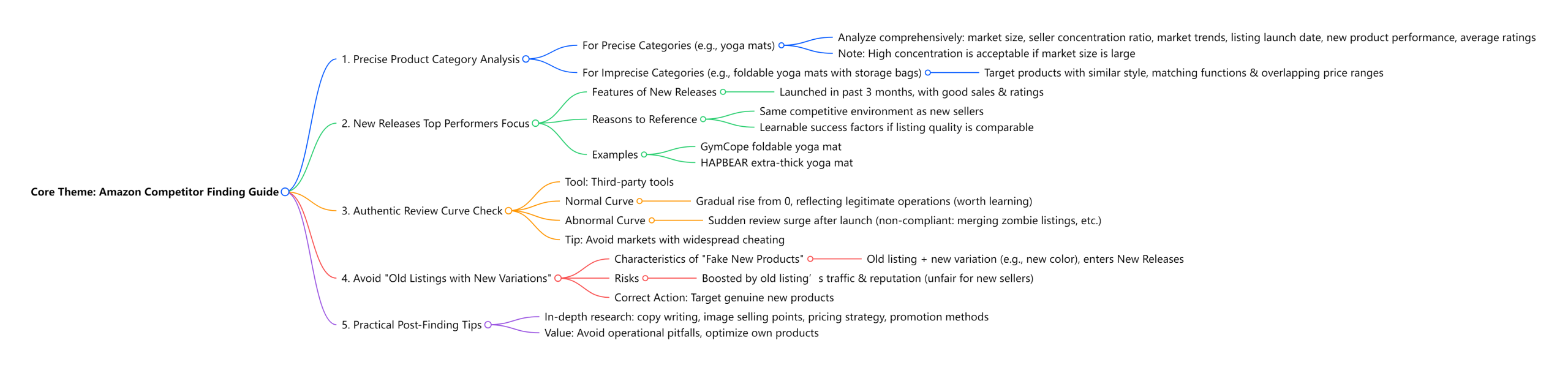
First, check if your product’s category is precise. If it is (e.g., you sell yoga mats), don’t rely on a single metric – analyze market size, seller concentration ratio, market trends, listing launch dates, new product performance, and average ratings comprehensively.
For example, some sellers get discouraged when they see high seller concentration. But if the market size is large enough, you can still capture a share even with slightly higher concentration – it’s totally viable.
If the category is imprecise (e.g., you sell “foldable yoga mats with storage bags”), analyzing broad category data is useless. Instead, directly target products with similar styles, comparable functions, and overlapping price ranges. Monitoring their performance will never steer you wrong.
2. Focus on “Top Performers” in New Releases
Amazon’s New Releases chart (like the one for yoga mats) features products launched in the past three months that are selling well. These products started around the same time as yours and face the same competitive environment – if they succeed, you can too as long as your listing quality measures up.
This also helps you gauge if the category is friendly to new products. For instance, in the yoga mat New Releases, items like GymCope’s foldable yoga mat and HAPBEAR’s extra-thick yoga mat were launched in the past three months and boast solid ratings and sales. These are perfect competitor benchmarks.
3. Verify the Authenticity of Review Curves
Always check competitors’ review growth curves with third-party tools . A curve that gradually rises from zero means the product was built through legitimate operations – this is the kind of competitor worth learning from.
But if a listing gets a flood of reviews right after launch, it’s likely using non-compliant tactics like merging zombie listings . Never treat these as benchmarks.
More importantly, if many sellers in a category use such tactics, avoid the market entirely. Legitimate operations can’t compete with cheating, and even if you outperform them fairly, they might sabotage you – the risks far outweigh the rewards.
4. Avoid the Trap of “Old Listings with New Variations”
Sometimes the New Releases chart has “fake ‘new products'” – actually new variations of old listings . For example, a yoga mat listing that’s been selling for six months might add a color variation and land in New Releases.
This makes the category seem new-product-friendly, but the new variation is actually boosted by the old listing’s traffic and reputation. New sellers without established listings can’t compete. So target genuine new products, not derivatives of old ones.
Final Tip: Dig Deeper After Finding Competitors
Don’t just observe – conduct in-depth research . How is their copy written? What selling points do their images highlight? Is their pricing market-aligned or differentiated? Do they rely on ads or promotions?
Mastering these details will help you avoid countless pitfalls when building your own products.
That’s all for today. See you next time!