In the process of operating on the Amazon platform, appearance patent infringement is a major problem that sellers may face. The impact is not to be underestimated, and there are corresponding appeal ideas and preventive measures.
I. Impact of being found guilty of appearance patent infringement
When an Amazon store is found guilty of appearance patent infringement, the seller will face a series of adverse consequences. First of all, the product will be forced to be removed from the shelves, making it impossible for the product to continue to be sold on the platform, directly affecting the store’s revenue. Secondly, the store account may be restricted in operation rights, and in serious cases, it may even be directly closed, which is a heavy blow to the seller’s entire operation system. In addition, sellers may also face fines, legal proceedings and other issues, and even be banned from re-entering the Amazon platform, completely losing their eligibility to operate on the platform.
II. Appeal ideas for appearance patent infringement
In the face of the determination of appearance patent infringement, sellers are not helpless, and there are mainly two appeal ideas.
- “Prior” idea: If the circulation time of the seller’s product (whether its own or that of other sellers) in the market is earlier than the application time of the other party’s patent, then the patent is invalid for the seller’s product, and the seller can appeal on this basis.
- “Different” idea: According to the “full coverage principle”, if the design points of the seller’s product are less than the rights points specified in the patent, after professional comparison (not by visual judgment), it can be determined that it does not constitute infringement, which is also an effective appeal path.
III. Appeal steps in real cases (taking US station products as an example)
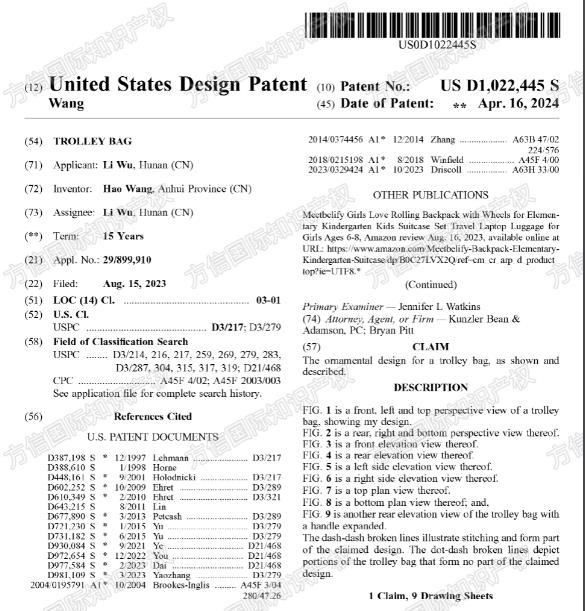
- Confirm the authenticity of the patent: The seller needs to contact the “Account Status Specialist” to obtain the other party’s patent number, and then check through the official website of the United States Patent and Trademark Office to confirm that the patent really exists and the similarity between the appearance of their own product and the patent is as high as 99%.
- Analyze the appeal angle: Due to the high similarity of product appearance, the “different” appeal angle is difficult to establish, so it is abandoned. Later, it was found that the product was put on the shelf in 2018, earlier than the application time of the patent in 2019, so the “prior” appeal angle was chosen.
- Contact the complainant: The seller sends an email to the complainant, explaining that their product was put on the shelf earlier and does not constitute infringement, and requests the other party to withdraw the complaint. Even if the complainant does not reply, this positive communication attitude will play a certain role in the appeal process.
- Prepare proof materials: The seller needs to obtain a screenshot of the proof of the product’s listing time and entrust a US lawyer to issue a non-infringement legal opinion from the “prior” perspective.
- Submit the appeal: After submitting the prepared legal opinions and other materials, the notice of approval and performance notice will be received in about 5 working days.
- Restore the product’s on-sale status: If the product link is still unavailable for sale, the seller can make any changes to the editing page and save and submit it. Usually, the link can be restored to the on-sale status within 10-15 minutes.
It should be noted that sellers should critically accept the suggestions of Amazon customer service. In this case, the customer service once thought that this appeal idea was invalid, but in fact, 3 similar cases successfully appealed through this idea.
IV. Preventive measures for appearance patent infringement
- Sellers should understand the patent laws and regulations of the country or region where they sell, clarify the definition of infringement, and have a clear understanding.
- Before launching new products, a thorough patent investigation should be carried out to understand the market and related patent information, so as to avoid infringement due to lack of information.
- For key products intended for long-term development, sellers should take the initiative to apply for their own patents, which can not only prevent being copied by others, but also reduce their own infringement risks.
- It is necessary to regularly monitor competing products in the market, pay attention to changes in their designs, and once similar designs are found, consult legal opinions in a timely manner and make preparations for response.
- Strictly abide by the platform rules and do not use other people’s brand logos, trademarks, designs and other intellectual property elements.
In conclusion, Amazon sellers should fully recognize the seriousness of appearance patent infringement, actively respond to infringement complaints, and do a good job in prevention to ensure the normal operation and long-term development of the store.